|

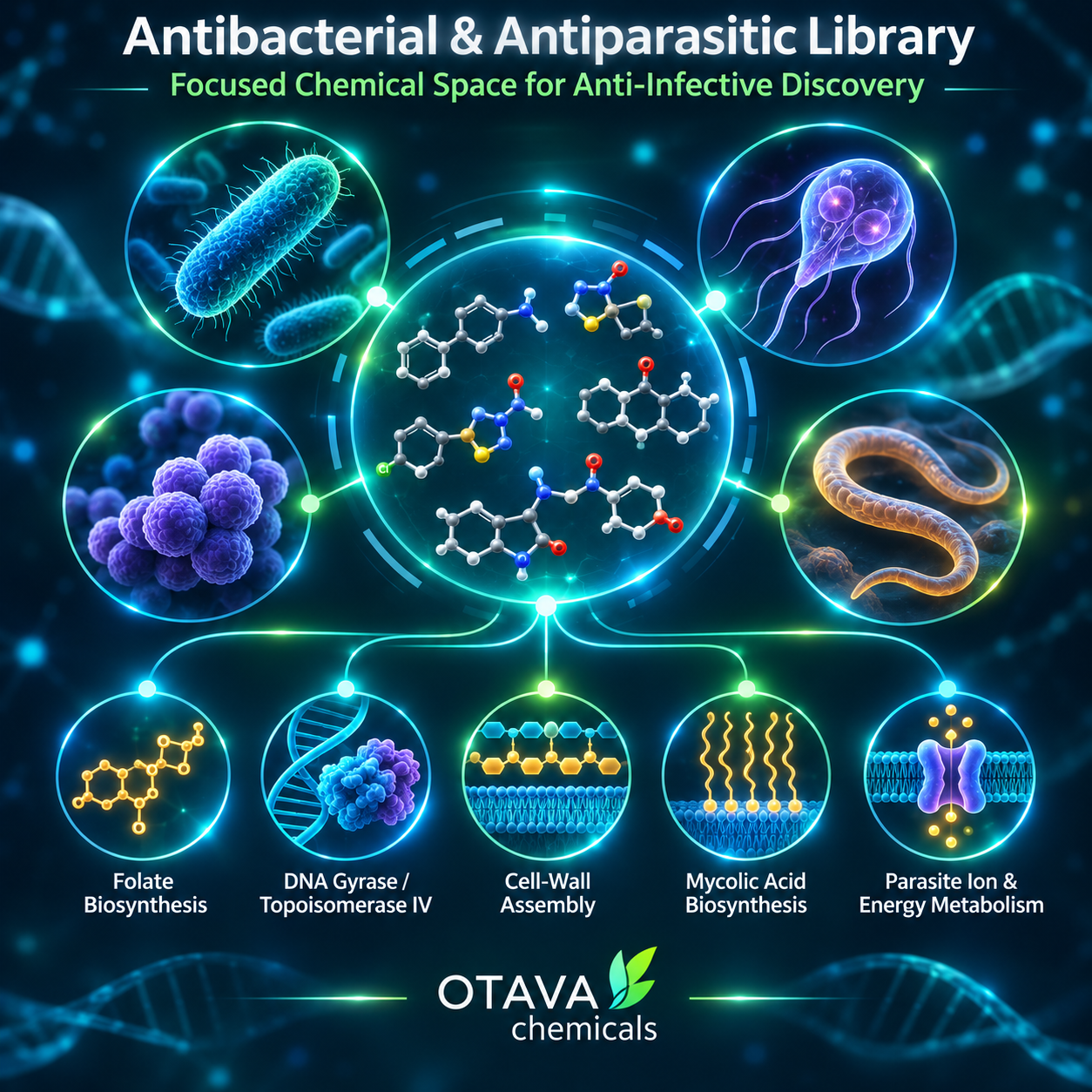
Antibacterial and antiparasitic agents act on biochemical processes that are essential to the pathogen and absent or substantially different in the human host — among them folate biosynthesis, DNA gyrase and topoisomerase IV, cell-wall assembly, mycolic acid biosynthesis and parasite-specific ion and energy metabolism. Chemotypes that engage these processes, such as sulfonamides, quinolones, nitrofurans, nitroimidazoles, benzimidazole anthelmintics and antimycobacterial hydrazides, have remained productive starting points for medicinal chemistry for decades.
The therapeutic need in this area continues to grow. Bacterial antimicrobial resistance was associated with an estimated 4.95 million deaths worldwide in 2019, of which 1.27 million were directly attributable to resistant infections [5], while parasitic diseases such as schistosomiasis, helminthiases and malaria remain a major global burden with a limited and ageing therapeutic arsenal. Both fields require new chemical matter around validated anti-infective scaffolds.
The OTAVA Antibacterial & Antiparasitic Library was developed using a data-driven ligand-based workflow in which the reference set was derived from in-stock approved anti-infective drugs and then used to search the OTAVA compound stock for structurally related molecules.
The following computational approaches were employed during the library design process.
1. Reference Set of Approved Anti-Infective Agents
The reference set was extracted from the OTAVA Annotated Bioactives Library, a collection of in-stock compounds carrying curated bioactivity and drug annotation from the ChEMBL database [1]. Candidate compounds were first identified by their recorded clinical indications in infectious disease, and the resulting set was then manually curated: indication records also capture comorbidities and supportive therapies, so compounds that are not themselves anti-infective agents — immunosuppressants, proton pump inhibitors, local anaesthetics, amino acids and simple preservatives among them — were excluded, together with trivial chemotypes that would contribute only generic analogues.
This procedure yielded 114 approved anti-infective drugs available from stock, covering the principal therapeutic classes:
-
sulfonamides — sulfamethoxazole, sulfadiazine, sulfathiazole and related antifolates
-
quinolones — from nalidixic and oxolinic acids to the fluorinated generations
-
nitrofurans and nitroimidazoles — nitrofurantoin, nitrofurazone, metronidazole, tinidazole
-
antimycobacterial agents — isoniazid, pyrazinamide, protionamide, aminosalicylic acid
-
antiparasitic agents — praziquantel, albendazole, mebendazole, pyrantel, chloroquine, artesunate
-
β-lactams, β-lactamase inhibitors, macrolides and aminoglycosides, together with azole and polyene antifungals and a smaller number of antiviral agents
Because the reference compounds originate from the stock itself, each of them is available for direct experimental comparison alongside the compounds selected around it.
2. Molecular Representation and Similarity Screening
Structures were standardised with the ChEMBL Structure Pipeline [2], which reduces salts and solvates to their parent forms, and each compound was then encoded using Morgan fingerprints (ECFP4, 2048 bits) [3], capturing its structural features as circular substructure patterns.
Tanimoto similarity was computed between every stock compound and each reference drug, and every molecule was assigned the maximum similarity to its nearest reference compound. The full OTAVA compound stock, comprising approximately 300,000 small molecules, was screened in this manner.
3. Similarity-Based Selection
Compounds were prioritised according to their maximum Tanimoto similarity to the reference drugs. A similarity threshold was applied to retain molecules with meaningful structural relatedness to validated anti-infective chemotypes while excluding structurally unrelated compounds.
For every selected compound, the nearest reference drug, its ChEMBL identifier and its recorded indications are provided in the library files, so that each entry carries an explicit link to the approved agent that motivated its selection. The selected compounds are distributed across the principal reference classes, with the sulfonamide, quinolone, antimycobacterial, nitrofuran and anthelmintic scaffolds most strongly represented.
4. Drug-likeness Filtering and Quality Control
The similarity-selected compounds were filtered using Lipinski’s Rule of Five and related physicochemical criteria:
-
Molecular weight ≤ 500 Da
-
LogP ≤ 5
-
Hydrogen bond donors ≤ 5
-
Hydrogen bond acceptors ≤ 10
-
Topological polar surface area ≤ 140 Ų
-
Rotatable bonds ≤ 10
Compounds matching pan-assay interference (PAINS) substructure filters [4] were removed, and all entries were cross-checked against the OTAVA compound database to confirm structural identity and stock availability. The approved reference drugs were retained irrespective of the physicochemical criteria above.
The final library exhibits a drug-like physicochemical profile (median molecular weight ~383 Da, median LogP ~2.7, median TPSA ~97 Ų), consistent with favourable properties for biological evaluation and further optimisation.
The resulting OTAVA Antibacterial & Antiparasitic Library contains 1,015 compounds, combining 114 approved anti-infective drugs with 901 structurally related molecules selected from the OTAVA stock.
The library combines:
-
a curated reference set of in-stock approved anti-infective drugs
-
fingerprint-based similarity screening
-
drug-likeness optimisation and per-compound provenance
making it a valuable resource for antibacterial, antimycobacterial and antiparasitic hit identification, scaffold expansion around established anti-infective chemotypes and research into antimicrobial resistance.
References
[1] Zdrazil, B. et al. The ChEMBL Database in 2023: a drug discovery platform spanning multiple bioactivity data types and time periods. Nucleic Acids Res. 52, D1180–D1192 (2024).
[2] Bento, A. P. et al. An open source chemical structure curation pipeline using RDKit. J. Cheminform. 12, 51 (2020).
[3] Rogers, D. & Hahn, M. Extended-connectivity fingerprints. J. Chem. Inf. Model. 50, 742–754 (2010).
[4] Baell, J. B. & Holloway, G. A. New substructure filters for removal of pan assay interference compounds (PAINS) from screening libraries and for their exclusion in bioassays. J. Med. Chem. 53, 2719–2740 (2010).
[5] Antimicrobial Resistance Collaborators. Global burden of bacterial antimicrobial resistance in 2019: a systematic analysis. Lancet 399, 629–655 (2022).
All the compounds are in stock, cherry-picking is available.
The libraries (DB, SD, XLS, PDF format) as well as the price-list are available on request. Feel free to contact us or use the online form below to send an inquiry if you are interested in obtaining this library or need more information.
Request Your Library Today! Fill out the form:
|

 HOME
 Overview